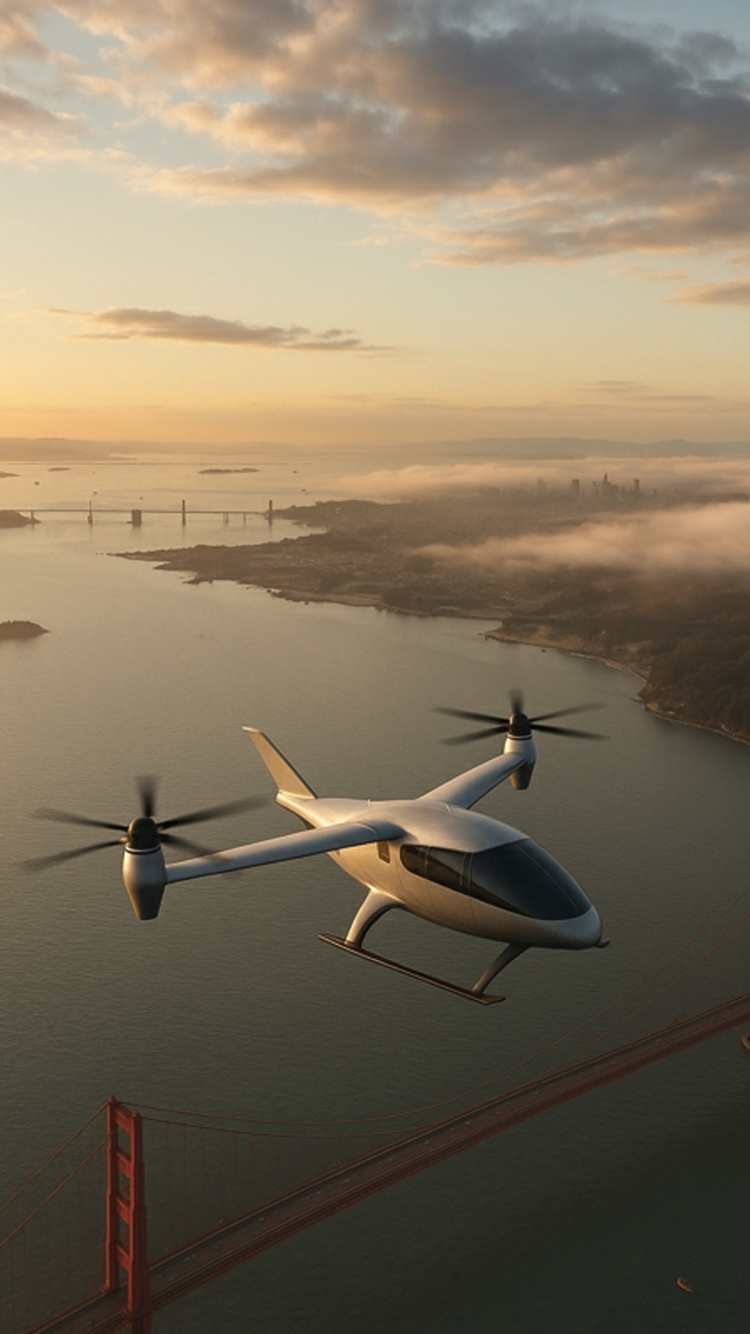

When Testing a New Aircraft No Longer Means Taking It Airborne
Before a new eVTOL completes its first crewed flight, how many tests does it need to pass? Under FAA airworthiness certification requirements for novel aircraft configurations, flight test programs routinely log thousands of hours from prototype to certification — at a cost that frequently exceeds $100 million. Throughout those thousands of hours, any unpredicted wind shear event, sensor malfunction, or flight control logic flaw carries the risk of a catastrophic loss — along with years of schedule delays and the prospect of restarting the certification process from scratch.
For the rapidly expanding eVTOL and drone industry, this is a barrier of enormous consequence. The global eVTOL market is projected to grow from approximately $1.1 billion in 2023 to over $37 billion by 2030 (Markets and Markets, 2023). Yet the prohibitive cost of physical flight testing and its inherent safety risks remain among the most significant obstacles preventing startups from reaching market.
Flight simulation digital twin technology is fundamentally rewriting this equation.
What Is a Flight Simulation Digital Twin?
The digital twin concept was pioneered by NASA and systematically formalized by Lockheed Martin into a five-level maturity model — ranging from basic geometric models at Level 1 to fully synchronized, bidirectional physical-digital mirrors at Level 5. In aerospace, a flight simulation digital twin is not a 3D animation or a game engine visualization. It is a high-fidelity computational system that maps an aircraft’s aerodynamic characteristics, flight control logic, sensor models, and environmental physics into a virtual space with engineering-grade accuracy.
The core proposition is straightforward: before a vehicle ever leaves the ground, engineers can conduct thousands of virtual test flights in digital space, systematically covering extreme operating conditions, flight envelope boundaries, and failure mode scenarios. According to McKinsey Global Institute, digital twin adoption in aerospace can compress product development cycles by 25 to 50 percent and reduce physical testing costs by more than 30 percent. For long, high-stakes aircraft programs, these are not marginal improvements.
The Technical Pillars of Aviation Digital Twins
Physics Fidelity: The Foundation That Cannot Be Compromised
A flight simulation digital twin is only as credible as its underlying physics engine. The industry benchmark is rigid-body flight dynamics solvers — with a long track record in both military and commercial aviation simulation — capable of modeling six degrees of freedom (6DOF) flight dynamics with full aerodynamic coefficient tables, propulsion models, ground reaction forces, and atmospheric effects.
At this level of fidelity, the stall behavior, spin entry dynamics, and ground effect characteristics observed in the digital twin align with real-world aircraft responses at engineering precision. For eVTOL development teams, this means rotor-rotor aerodynamic interference in multirotor configurations and the complex transition dynamics of tilt-rotor designs can be rigorously characterized before a single airborne test.
Visual Rendering: Building Situational Awareness, Not Just Imagery
Beyond physics accuracy, visual fidelity is a critical dimension of the flight simulation digital twin — particularly for pilot training and mission planning applications. Digital twin-grade visualization systems operate at photorealistic 3D rendering quality, reproducing accurate terrain, dynamic weather visuals, night vision and infrared optical modes, and precise cockpit instrument displays.
This is not an aesthetic consideration. High-fidelity visual environments have been shown in multiple military aviation training studies to meaningfully improve situational awareness during simulator training, leading to better transfer of learned behaviors to actual flight. When pilots practice low-visibility instrument approaches or emergency procedures in a photorealistic environment, the cognitive familiarity built in simulation has measurable operational value.
Multi-Aircraft Architecture: One Platform, Every Configuration
Modern aviation programs rarely involve a single aircraft type. A mature flight simulation digital twin platform must support fixed-wing aircraft, helicopters, multirotor drones, and eVTOL configurations within a unified architecture — allowing development teams to switch between vehicle types, run comparative performance analyses across configurations, and iterate rapidly on novel designs without being constrained by platform limitations.
For the next generation of aircraft exploring hybrid-wing layouts, distributed electric propulsion, or autonomous flight systems, this architectural flexibility ensures that the simulation platform scales with innovation rather than becoming a bottleneck to it. Engineering teams can adjust aerodynamic geometries, tune control law parameters, and immediately observe downstream effects on flight dynamics — all in digital space, at a fraction of the cost of physical prototyping.
Weather and Sensor Simulation: Testing Where Accidents Actually Happen
The two categories of conditions most difficult to reproduce in physical testing are also the leading contributors to aviation accidents: complex meteorological environments (wind shear, turbulence, icing conditions) and sensor failures (GPS outages, IMU drift, camera obscuration).
Advanced flight simulation digital twin platforms integrate weather modeling modules capable of generating physically consistent wind fields, precipitation, and visibility degradation for stress-testing flight control algorithms under adverse conditions. Simultaneously, sensor simulation modules replicate the authentic output of cameras, LiDAR, and millimeter-wave radar sensors — providing a standardized data generation environment for the sim2real transfer of perception algorithms. For teams developing autonomous flight systems, this capability is not optional; it is the primary path to validated autonomy at acceptable risk.
Four Concrete Application Scenarios
eVTOL and Drone R&D Test Simulation
For unmanned and electric aircraft manufacturers, the most direct value of a flight simulation digital twin is compressing the physical test risk window. Iterative flight control algorithm validation, flight envelope exploration under extreme weather, emergency landing logic verification under battery depletion — scenarios that are expensive or dangerous in physical test programs can be systematically addressed in digital space at high frequency and low cost.
Leading eVTOL developers have already adopted a simulation-to-flight ratio exceeding 100:1, meaning more than 100 hours of digital twin simulation validation precede every hour of physical airborne testing. This ratio directly translates to reduced accident probability, faster certification timelines, and lower program cost.
Flight Schools and Pilot Training
The global pilot shortage continues to deepen. Boeing forecasts that more than 640,000 new pilots will be needed worldwide over the next two decades. Flight simulation digital twins offer aviation academies and training organizations an economically viable path to scale: dramatically lower cost-per-flight-hour while maintaining training rigor, and the ability to safely practice emergency procedures, instrument approaches in low visibility, and abnormal systems management — high-risk maneuvers that carry significant cost and safety implications in live aircraft.
Military and Defense Flight Training
Defense aviation has long relied on simulation for training, but requirements around data sovereignty and platform independence have grown more demanding. Military-grade flight simulation digital twin platforms must operate in air-gapped network environments, support mission planning rehearsal, tactical maneuvering training, and type conversion for new aircraft. Domestically developed solutions built without dependency on foreign software licenses address both the operational security requirement and the broader policy imperative for technology independence in defense-critical systems.
Aviation Exhibitions and Immersive Experience Displays
For aviation brands and exhibition venues, a flight simulation digital twin enables an interactive experience that static scale models fundamentally cannot deliver. Visitors can “fly” a company’s flagship aircraft type, experiencing its handling characteristics and performance envelope firsthand. Beyond the experiential value, this format communicates technical depth and innovation credibility in a way that brochures and videos cannot match.
A Platform Built for This Moment
Until recently, bringing all of these capabilities together in one platform was something only major defense contractors and the largest OEMs could do. That is changing.
Flyward’s FDT Flight Simulation Digital Twin platform integrates high-fidelity aerodynamic simulation with photorealistic 3D engine rendering and supports fixed-wing, rotorcraft, and eVTOL configurations within a single architecture. The platform is designed for aviation schools, drone and eVTOL R&D teams, defense institutions, and exhibition venues — with full data localization to meet domestic deployment and data compliance requirements. Flyward also maintains an active simulation validation collaboration with the Microsoft AirSim team, continuously advancing the platform’s simulation fidelity and scenario coverage.
Looking Ahead: Toward a Digital-First Aviation Engineering Paradigm
The value boundary of flight simulation digital twins is expanding rapidly. As neural rendering technologies — Neural Radiance Fields (NeRF) and 3D Gaussian Splatting (3DGS) — mature toward production readiness, the efficiency of real2sim conversion (reconstructing real-world environments into simulation-ready digital twins) is approaching a cost floor that makes comprehensive terrain modeling and airport environment reconstruction economically trivial.
Equally significant is the intersection of flight simulation digital twins with AI-driven autonomous flight development. The emerging paradigm: autonomous flight control algorithms complete billion-scenario training runs inside digital twins, then transfer to physical aircraft through rigorous sim2real validation protocols. This approach has already demonstrated its validity in autonomous vehicle development. Aviation is a more demanding domain — but the underlying logic is the same, and the transition is underway.
For the aviation ecosystem as a whole, the critical insight is this: physical flight testing will always be necessary for final certification. But the programs that will succeed — on timeline, on budget, and on safety record — will be those that arrive at physical testing having already resolved the vast majority of their unknowns in digital space. The flight simulation digital twin is not a replacement for flight. It is the infrastructure that makes flight testing rational.