
Advanced Autonomous Flight SystemAutonomy from hangar to hangar.
Autonomy across the whole flight: leaving the hangar, taxiing, takeoff, cruise, arrival, approach, landing, entering the hangar and parking, with the aircraft under autonomous control from start to finish.
- 01Hangar exit
- 02Taxi
- 03Takeoff
- 04Cruise
- 05Arrival
- 06Approach
- 07Landing
- 08Hangar entry
- 09Parking
Autonomous control, from start to finish.
The Advanced Autonomous Flight System is designed around the whole flight: from leaving the hangar, taxiing and takeoff, through cruise, arrival, approach and landing, to entering the hangar and parking, it brings every phase under autonomous control.
It is built on two layers. The first is single-aircraft autonomous flight functions: onboard navigation and positioning fusion, an onboard terrain and building database, 3D synthetic vision and real-time route planning. The second is single-aircraft autonomous flight systems: autonomous takeoff, landing, return-to-home and emergency landing. The flight control system underneath is our own too, built for eVTOL, UAV and fixed-wing manufacturers.
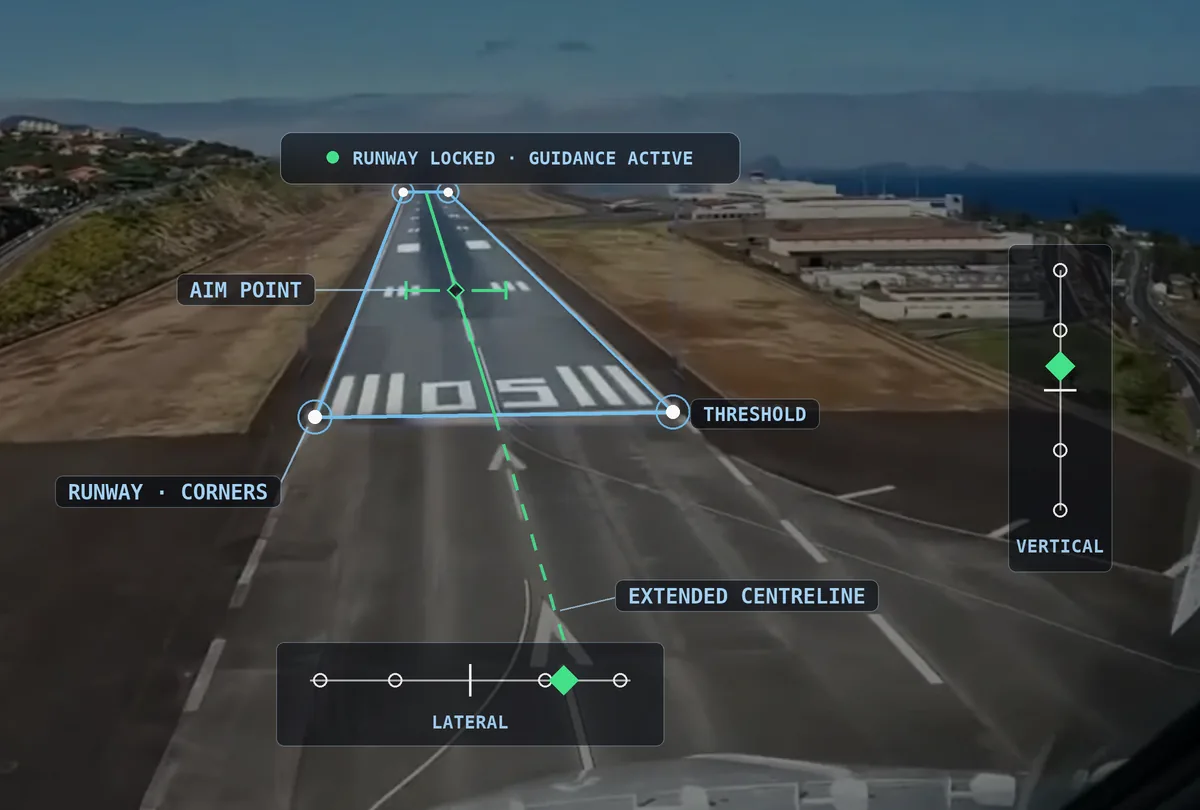 Illustrative · visual landing guidance
Eyes on the runway, from approach to takeoff roll.
The onboard visual takeoff and landing guidance system recognises the runway and landing site in real time throughout approach, landing and the takeoff roll. It works out the lateral offset from the runway centreline, the vertical offset from the glide path and the position relative to the touchdown point, and passes them to the flight control system. No ILS or other ground guidance is needed, so it also works on runways and simple airstrips without instrument landing aids.
- Runway outline and cornersThe runway boundary and its four corner points
- Centreline and aim pointLined up on the runway centreline, with the aim point marked
- Lateral and vertical deviationGuidance passed to the flight controller in real time
- 95%About 95% runway recognition accuracyMeasured recognition accuracy (mAP50)
From perception and positioning to takeoff, landing and return.
Single-aircraft autonomous flight functions
Navigation and Positioning Fusion
Integrates multiple navigation devices such as GNSS, INS and altimeters, with robustness beyond traditional filtering algorithms.
Learn moreOnboard Terrain and Building Database
An offline digital terrain database covering all of China, plus building-height data for major cities.
Learn more3D Synthetic Vision
Builds 3D environment maps from visible-light, infrared, radar and other sensor data to give vision in low visibility and at night, with multi-view panoramic stitching for a wider field of view.
Learn moreReal-Time Route Planning
Plans routes around terrain, buildings, no-fly zones and airspace rules, and replans automatically if communications fail; online 3D path planning is already integrated into our 4D airspace platform.
Learn moreSingle-aircraft autonomous flight systems
Autonomous Takeoff
Identifies runway areas, markings and obstacles at airports and helipads, then taxis and takes off on its own.
Learn moreAutonomous Landing
Identifies the airport area, helipad or runway, then flies the approach and landing.
Learn moreAutonomous Return-to-Home
Visual return navigation and global return planning bring the aircraft back, or down safely, even when GPS, IMU or ground links fail.
Learn moreEmergency Landing
When something goes wrong, looks for somewhere to land, recognising emergency sites such as highways and simple airstrips and guiding the aircraft down.
Delivered as software modules, built into your avionics.
Tailored to your aircraft, sensors and project, with output rate, latency and guidance accuracy defined together with you.
- Delivery
- Software modules that work with a range of cameras, pods and onboard computers
- Interfaces
- Serial, CAN, UDP and more, adapted to your avionics architecture
- Operating systems
- Linux and real-time operating systems (RTOS), on multiple processor architectures
- Certification
- Software development planned against DO-178C and other civil airworthiness standards, to support later certification
How we work together
- 01Feasibility study and simulation
- 02Prototype and hardware-in-the-loop testing
- 03Integration on the aircraft and flight testing
Let’s define your aircraft’s autonomy together.
Tell us about your aircraft, mission and verification requirements, and we’ll define the functions and performance targets with you, project by project.